Field manual · Evidence · 6 min read
Direct evidence vs. circumstantial evidence: a detective's primer

Most players reach for the loud clue: the witness who saw the whole thing, the confession, the camera that caught the killer. Those are rare in a well-built mystery, which is why almost every case is actually closed with the other kind of evidence. Knowing which kind you are holding tells you how much weight it can carry, and what you still need before you accuse anyone.
The difference in one line
Direct evidence proves a fact on its own, with no reasoning required: someone watched the act happen, a recording caught it, or the person admitted it. Circumstantial evidence proves a fact that points to the conclusion, and you have to take one step of thinking to get there.
A witness who says 'I saw her raise the gun and fire' is direct evidence of the shooting. Her fingerprints on the gun are not: they prove she touched it, and you supply the step from 'touched it' to 'fired it'.
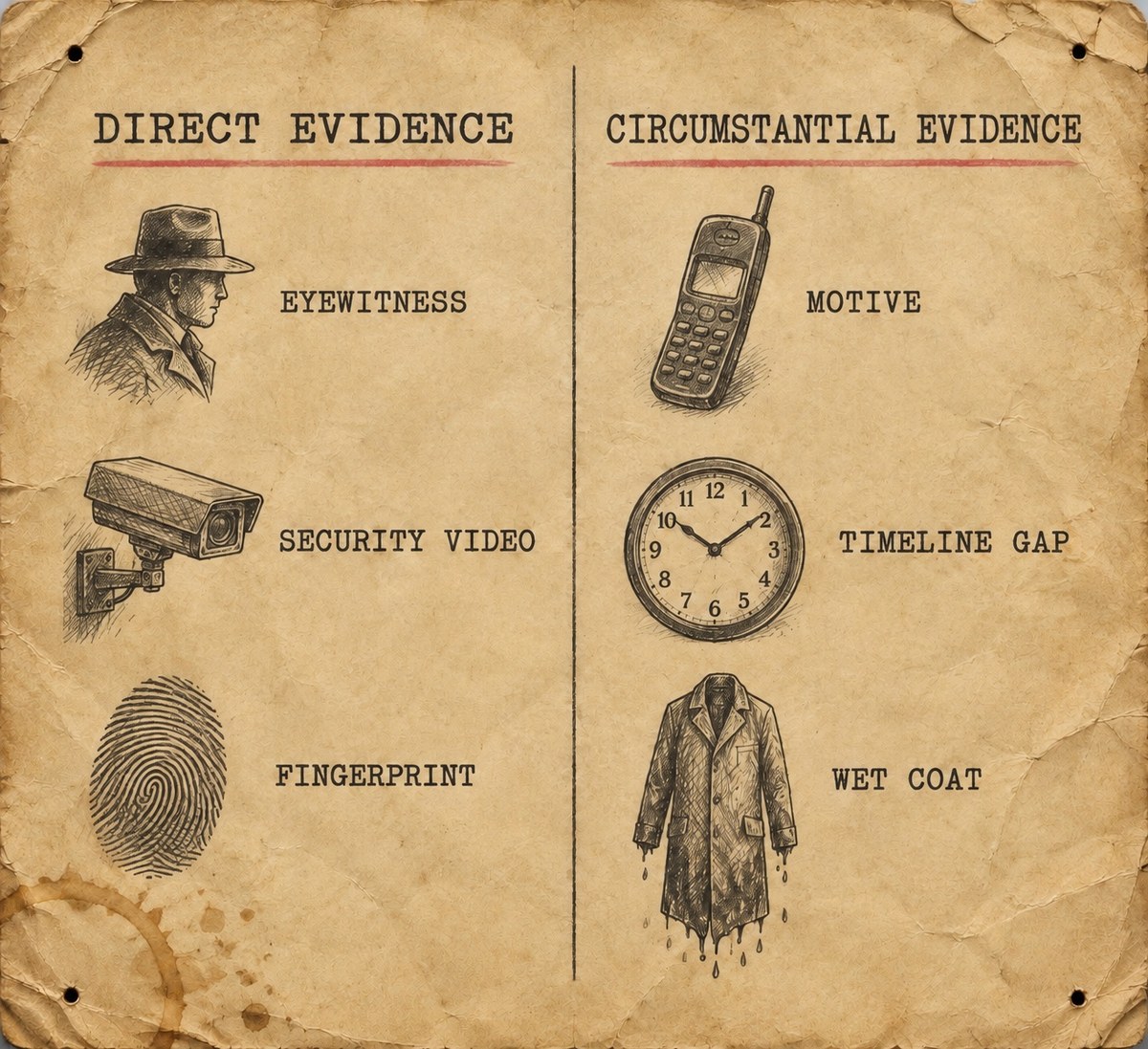
- Direct evidence: an eyewitness to the act, a recording of the act, a confession.
- Circumstantial evidence: motive, access to the weapon, a gap in the timeline, a lie about where they were.
- The same object can be both: a fingerprint is direct proof of contact and circumstantial proof of the crime.
What direct evidence actually is
Direct evidence answers the question without asking you to fill anything in. The witness saw the killing. The doorbell camera filmed the doorway at 9:45. The suspect wrote down what they did.
It is worth chasing first because it shortens the argument. If you have it, the rest of the case is about motive and proof, not about whether the killing can be traced to this person at all.
- An eyewitness who describes the act itself, not just the person nearby.
- A photo, video or audio recording that shows the act.
- A confession, or a written admission the suspect cannot take back.
- A signed document that places someone at a place at a stated time.
What circumstantial evidence actually is
Circumstantial evidence is a fact that fits one story better than another. A coat that is soaked through when it stopped raining at 9:20. A boot print in the hallway that matches the size of one suspect. Fifteen minutes nobody can account for, and a five minute walk to the scene.
None of those facts prove a murder by themselves. Each one narrows the field. Laid end to end, they can leave only one person who could have done it.
- Motive: what the person gained, protected or hid.
- Means: access to the weapon, the key, the lab or the account.
- Opportunity: unexplained minutes that are long enough to reach the scene.
- Behaviour after the fact: an object moved, a report requested, a story changed.
Why circumstantial evidence is not weak evidence
People hear 'circumstantial' and think 'not good enough'. In real courts, juries convict on circumstantial cases regularly, because a chain of facts that all point one way is hard to argue with, while a single eyewitness is easy to attack.
In a mystery game the same rule applies, and often for a simpler reason: the author rarely lets a witness watch the murder. The scene, the reports and the timeline are what the case was built from, so that is where the answer lives.
The trap: one piece is never enough
A single circumstantial fact almost always fits an innocent story too. A wet coat means they were out in the rain. A fingerprint means they visited last week. A timeline gap means they were alone in their own room, which nobody can confirm either way.
So test each fact with the same question: what would this look like if the suspect were innocent? If the evidence fits that story just as well, it is not proof, only a coincidence worth a note. If it does not fit, you have a link.
How to build the chain in a detective game
Work in this order and the case stops feeling like a guess.
- Write down the time of death and the location before you read any suspect's story.
- Search the scene for direct evidence first: a recording, a witness, a written admission.
- If there is none, list the circumstantial facts and sort them into motive, means and opportunity.
- Check every fact against an innocent explanation, and drop the ones that fit it.
- Put the surviving facts on one timeline until a single person is left standing at the same place at the same time.
- Only then accuse, and name the motive your evidence supports.
A lie is circumstantial evidence of something
A suspect who lies about where they were has handed you a fact, but not the fact you want. Innocent people lie to hide an affair, a debt, or an embarrassing evening. The lie is only useful once you know what it was protecting.
The culprit is the person whose lie is needed to cover the crime itself: the one whose missing minutes, access and physical traces all arrive at the same place at the same time.
Try it on today's case
Open today's case and sort every clue into the two piles as you find them. If the direct pile is empty, do not panic: build the chain from motive, means and opportunity and test each link against an innocent story. For the timeline work, read how to spot a fake alibi; for the full order of an investigation, read how to solve a detective case; and for the interviews that turn a chain into a confession, read how to interrogate suspects.
Questions from the bullpen
- What is the difference between direct and circumstantial evidence?
- Direct evidence proves the fact without any reasoning: a witness saw the act, a recording caught it, or the person admitted it. Circumstantial evidence proves a related fact and you supply the step that connects it to the crime, such as a fingerprint, a motive or a gap in the timeline.
- Is circumstantial evidence enough to solve a case?
- Yes. A chain of circumstantial facts that all point to one person, with no innocent explanation that fits them all, is enough to close a case. Most mystery games are built this way because no witness watches the murder.
- Can direct evidence be wrong?
- Yes. Witnesses misremember faces and times, recordings can be cropped or taken out of context, and confessions can be false or forced. Direct evidence still needs to be checked against the physical record.
- Is a fingerprint direct or circumstantial evidence?
- It is direct proof that the person touched that object, and circumstantial proof that they committed the crime. The step from touching to killing is the one you have to support with something else.
- Which kind of evidence should I look for first in a detective game?
- Search for direct evidence first, since it shortens the argument. If the scene has none, switch to building a circumstantial chain: motive, means, opportunity, then test every link against an innocent explanation.