Field manual · Alibis · 6 min read
How to spot a fake alibi (5 checks detectives use)
Every suspect has a story about where they were. Most of those stories are true, and one of them was built to protect a killer. You cannot tell which by how confident the suspect sounds. You tell by testing the story against things that cannot lie: the clock, the scene, and the people around it.
What an alibi actually claims
An alibi is three claims bundled together: I was at this place, during this time, and someone or something can confirm it. Split it into those three parts before you judge it. A story can be right about the place and wrong about the time, and that gap is usually where the lie lives.
- Place: where exactly were they, and could they get from there to the scene?
- Time: does the window they cover actually match the time of death?
- Proof: is it backed by a person, a record, or nothing at all?
Check 1: Line it up with the time of death
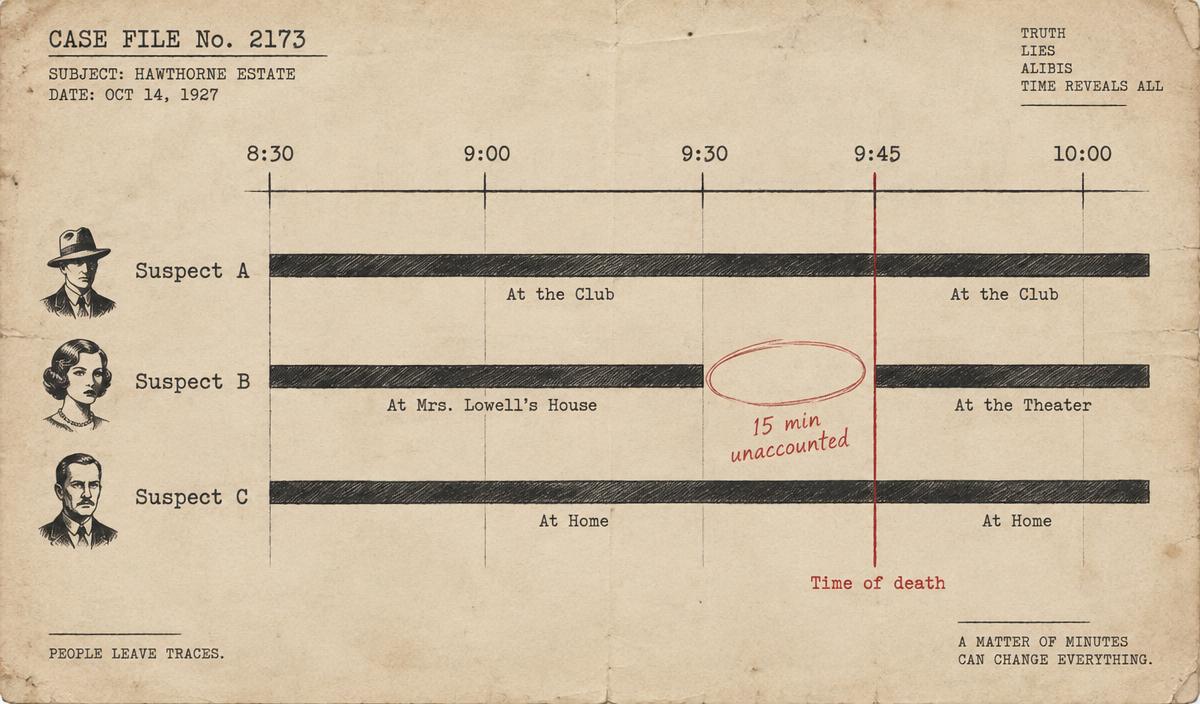
Write the time of death at the top of your notes and put every alibi on the same timeline. A suspect who accounts for 9:00 to 9:30 when the victim died at 9:45 has not given you an alibi at all, only a nice story about an unimportant half hour.
Look for the minutes nobody covers. Fifteen unexplained minutes and a short walk to the scene is all a culprit needs.
Check 2: Test it against physical evidence
People can rehearse a story; objects cannot. If a suspect says they never entered the study but their muddy boot print is on the rug, the alibi is finished. Go back to the scene and ask of each clue: who could have left this, and when?
Evidence works both ways. A receipt timed across town, or a lab report placing someone else at the scene, can clear a suspect just as firmly as a print can convict one.
Check 3: Who confirms it, and what do they gain?
An alibi is only as strong as the person backing it. A stranger with nothing at stake is worth more than a spouse, a business partner, or anyone who would also be in trouble if the story fell apart.
Ask what the confirming person actually saw. "We were together all evening" often shrinks to "I saw him at dinner and again around ten" once you press for detail.
Check 4: Too much detail, or the wrong detail
Honest memory is patchy. People remember what mattered to them and blur the rest. A suspect who recites exact times for an ordinary evening, unprompted, may have prepared that answer in advance.
Also watch for detail in the wrong place: a precise account of the film they watched, but nothing about who else was in the room. Rehearsed stories are strong where the liar expects questions and thin everywhere else.
Check 5: Watch what changes when you press
Put a piece of evidence in front of the suspect and repeat the question. A true account stays the same in its core facts. A false one shifts: the time moves, a new person appears, or the suspect suddenly remembers stepping out for a moment.
Any change is worth a note, even a small one. Compare the new version against your timeline and your clues, and see which version the evidence supports.
A true alibi can still hide a lie
Catching a suspect in a lie does not make them the killer. Innocent people lie about affairs, debts, and embarrassing habits all the time. Before you accuse, ask why they lied and whether that reason has anything to do with the murder.
The culprit is the person whose lie is needed to cover the crime itself: the one whose missing minutes, access, and evidence all point to the same place at the same time.
Try it on today's case
The best way to learn these checks is to use them. Open today's case, build the timeline from the brief, and test each suspect's story against the scene. For more on questioning, read the guide on how to interrogate suspects; for the full method, see how to solve a detective case.
Questions from the bullpen
- What is the fastest way to break an alibi?
- Put it on a timeline next to the time of death. Most false alibis cover the wrong window or leave a short gap that is enough to reach the scene.
- Does a lying suspect mean they are guilty?
- No. Innocent suspects often lie to hide something unrelated, such as an affair or a debt. Ask why they lied before treating the lie as proof of murder.
- Is a witness more reliable than a suspect?
- Usually, because a neutral witness has nothing to gain. Still check what they actually saw, since people often remember less than they first claim.
- Can physical evidence clear a suspect?
- Yes. A record or lab result placing someone elsewhere at the key moment can rule them out as firmly as a fingerprint can point to the culprit.